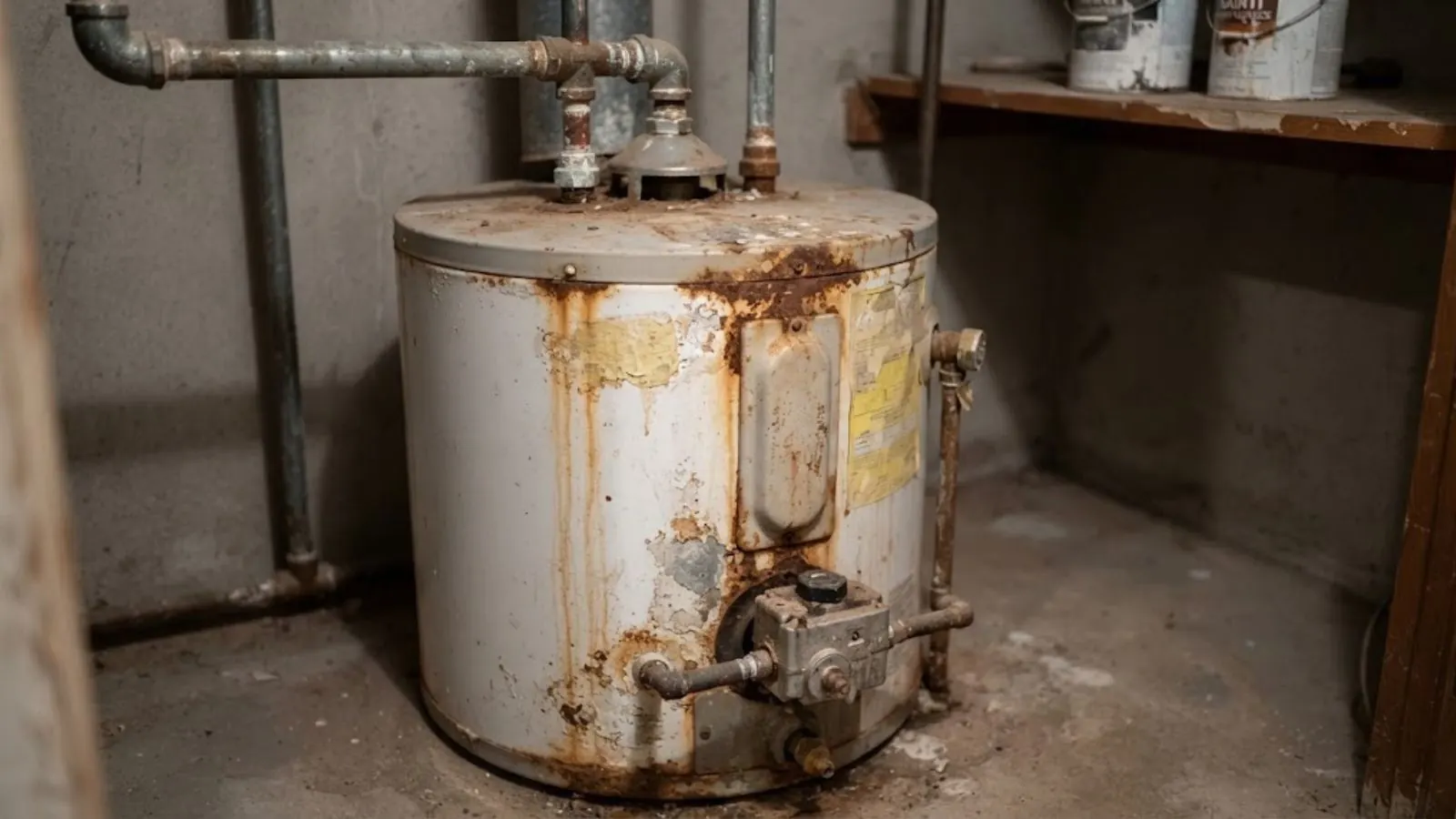
Every tank water heater has a limited life. Knowing roughly when to start planning a replacement saves you from a flooded closet and a cold shower. The question is not just how old the tank is, but how it has been treated and what it is telling you.
This guide covers the typical lifespan, the signs that a heater is nearing the end and what influences how long yours will last in San Bruno.
The typical lifespan
A standard tank heater commonly lasts around eight to twelve years. Electric tanks sometimes last a little longer than gas. Tankless units are often rated for much longer, but they need regular flushing.
These are broad ranges, not promises. A well-maintained tank can beat them, and a neglected one can fall short.
What shortens a heater's life
- Hard water scale on the tank floor and elements.
- A spent anode rod that never got replaced.
- High water pressure and no expansion tank.
- A tank installed in a damp or corrosive environment.
- Skipping annual flushing.
Signs a heater is near the end
| Sign | What it suggests |
|---|---|
| Rust-colored hot water | The tank interior or the anode rod is corroding |
| Rumbling or popping | Sediment is trapped on the tank floor |
| Moisture or rust at the base | The tank may be leaking |
| Frequent repairs | Parts are wearing out together |
| Less hot water than before | Scale insulating the water from the heat |
| Age over ten years | Failure risk rises sharply |
Plan the replacement, do not wait for the leak
A planned replacement lets you choose the right size and fuel, schedule the install on a convenient day and handle the permit properly. An emergency replacement is faster, but you pay for the rush and you may have less choice.
If your heater is in the final years, see water heater replacement for what the job involves, and water heater repair if a smaller part is failing.
Extending the life of a heater you plan to keep
- Flush yearlyDrain a few gallons from the tank drain valve to remove sediment.
- Check the anode rodInspect it every few years and replace it when it is worn.
- Test the relief valveLift the lever briefly to confirm water flows and the valve reseats.
- Check the straps and the areaMake sure the heater is strapped and the space around it is clear.
Tank or tankless on the next one
A replacement is the time to ask whether a different type makes sense. A tankless unit saves floor space and heats on demand, but it needs adequate gas and venting. A heat pump hybrid uses less electricity but needs space and airflow.
We explain the trade-offs without pushing a particular choice. See tankless water heater for the details.
A note on earthquakes
A water heater that falls in an earthquake can break gas and water lines. That is why California law requires bracing. A heater that has aged in place may have rusted straps or loose fasteners, and an inspection costs little compared with the risk.
What to do now
Check the age on the data plate, look for rust and moisture, and listen for rumbling. If your heater is past ten years and showing any sign, start planning. We can inspect it and give you a realistic view of how much life remains.
Repair or replace: a decision guide
| Situation | Usually better |
|---|---|
| Under six years old, one part failed | Repair |
| Six to ten years old, small leak at a fitting | Repair |
| Over ten years old, leaking from the tank | Replace |
| Over ten years old, repeated repairs | Replace |
| Rust-colored water from the tank itself | Replace |
| Gas control valve failed on an older tank | Often replace |
These are rules of thumb. A technician can look at your tank and give a specific view.
What changes when you replace
Replacing a heater is not always a straight swap. Newer tanks may be taller or wider, and codes have changed since the old unit went in. The vent, gas line, expansion tank, drain pan and seismic strapping may need updates.
Rules on residential water heater emissions in the Bay Area are changing, so ask about current requirements before you buy. We can explain what applies to your fuel type and what the permit process looks like.
Plan the removal too. A full tank is heavy, and a heater in an attic or closet needs a clear path. Tell us about stairs, tight doors or a crawlspace when you call so we can bring the right help. See water heater installation for the full process.
Questions to settle before you order
- What size do you need for the number of people and bathrooms?
- Is the old location still the best one, or should it move?
- Do you want to stay with the same fuel type?
- Does the space allow a drain pan and a drain line?
- Who handles the permit and the inspection?
- What does the warranty cover, parts only or parts and labor?
Settling these first turns the install into a scheduled job. It also avoids the common surprise of a heater that fits the budget but not the closet.
Plumbing problem that cannot wait?
Call the 24/7 line. A dispatcher answers and starts with the first steps.
California bracing law and San Bruno geography
California Health and Safety Code section 19211 says new and replacement water heaters, and all existing residential water heaters, shall be braced, anchored or strapped to resist falling or horizontal displacement due to earthquake motion, and at a minimum in accordance with the California Plumbing Code. San Bruno sits near the San Andreas Fault, and San Andreas Lake, named for the fault, lies just outside the city limits.
The same page of local facts includes hardness data. The City of San Bruno's 2023 report puts local groundwater hardness at an average of 215.6 ppm, which can shorten a tank's life through scale. If you are choosing a replacement for a home in Millbrae or Burlingame, both of which use only regional system water, scale is a smaller worry.
Source type: California Health and Safety Code section 19211 and City of San Bruno 2023 Water Quality Report. Facts are stated according to each agency's own published page.
Questions about this topic
Many last roughly eight to twelve years, though water quality, usage and maintenance change that. Tanks in hard water areas often fall at the short end, and a heater that has been flushed and has a fresh anode rod may last longer.
Look at the data plate on the side of the tank. The serial number often contains the year and month of manufacture, but the code varies by brand. Send us a photo and we can decode it.
If it is past ten years old and showing signs of age, planning a replacement gives you time to choose a unit and schedule the install. Waiting for a failure usually means a flooded closet and a rushed decision.
California law requires water heaters to be braced, anchored or strapped against earthquake movement. If your straps are loose, missing or old, we can fix them during any visit.