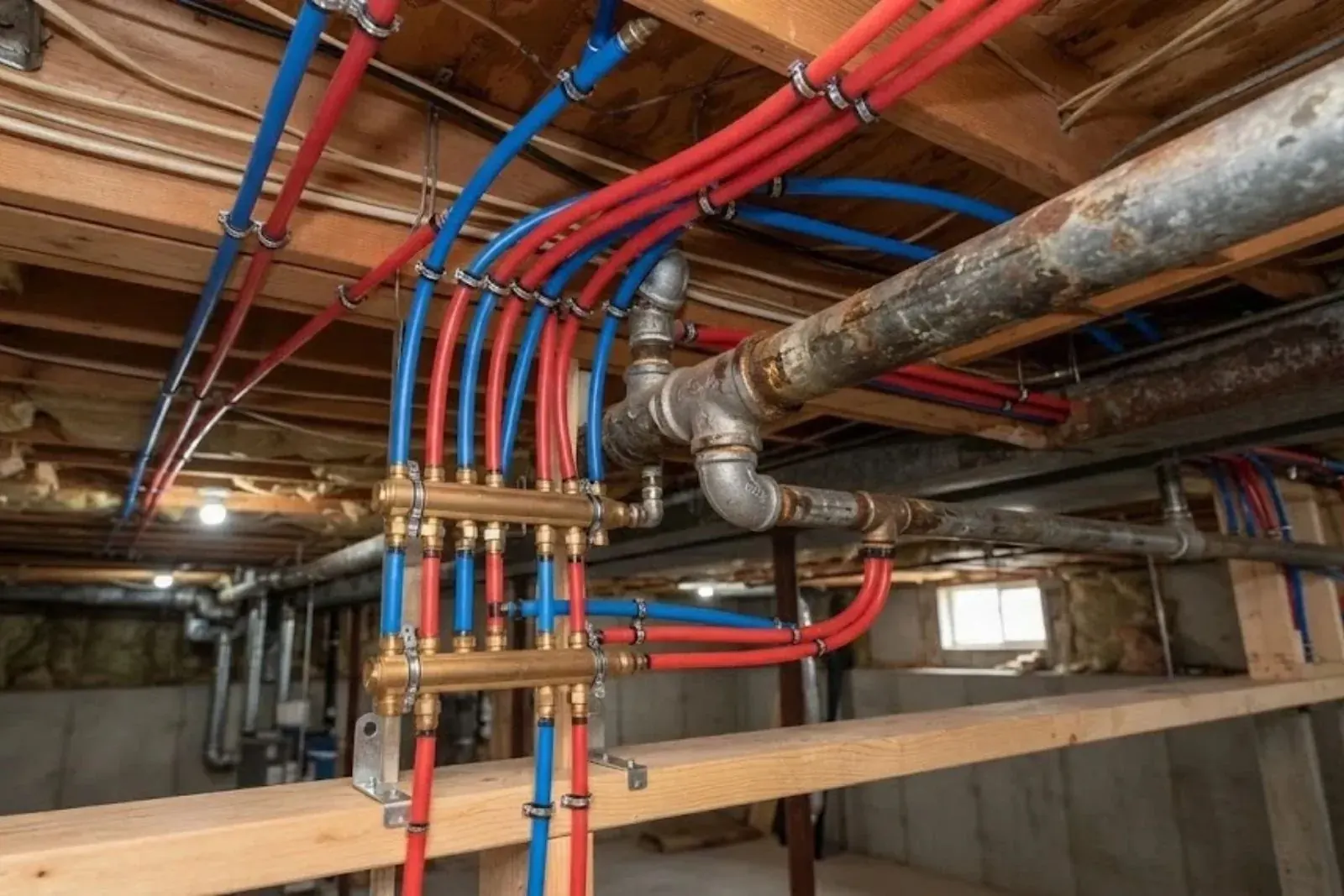
Homeowners ask about copper to PEX when old pipes start to leak. PEX, short for cross-linked polyethylene, has become the common material for new supply lines. Moving from copper to PEX is a reasonable step in many houses, but it is not automatic. The right choice depends on the condition of your copper, your access and your budget.
This guide explains how the two compare and how a conversion actually works in a San Bruno home.
Why homeowners switch from copper to PEX
The usual trigger is leaks. Copper in older homes can develop pinholes from corrosion, and repairing one often reveals other thin spots. Replacing the whole run with PEX stops the cycle.
PEX also installs faster. It comes in coils, bends around corners and needs fewer joints. That means fewer wall openings and less patching.
Copper and PEX compared
| Feature | Copper | PEX |
|---|---|---|
| Flexibility | Rigid, needs elbows and joints | Flexible, fewer fittings |
| Corrosion | Can pit and corrode in some water | Does not corrode |
| Freezing | Can split | Expands and often survives |
| Sunlight | Not affected | Must be shielded from UV |
| Joints | Soldered or pressed | Crimped, clamped or expanded |
| Installation time | Longer | Shorter |
How a conversion works
- Plan the layoutWe decide whether to use a manifold system or branch lines and mark access points in walls and floors.
- Open and runWe make small openings, run new PEX to each fixture and connect it with rated fittings.
- Connect and testWe join the new lines to the main and water heater, then pressure test the system.
- Inspect and patchAfter inspection, we patch the openings. Paint is left to you.
Whole-house or partial
Some homes need only a section replaced, such as a leaking run in a crawlspace. Others benefit from a full conversion. If leaks keep appearing in different spots, a full job is usually more cost-effective than a series of repairs.
See repiping for the whole-house option. If a single pipe has failed and you need a quick repair, burst pipe repair covers that.
What to watch for during a conversion
- Use fittings and tools rated for the specific PEX type.
- Protect PEX from sunlight where it is exposed.
- Keep PEX away from hot flues and recessed lights.
- Support runs properly so they do not sag.
- Pressure test before closing walls.
Water heaters and PEX
Many installers use copper or rated connectors for the first few inches off a gas water heater, since heat and flue gases are hard on plastic. We follow the manufacturer's requirements at the heater and use proper transitions.
A thermal expansion tank is part of many setups, especially when a pressure regulator makes the system closed. We check this on every conversion.
Cost factors
A conversion's price depends on the size of the house, the number of fixtures, access to the pipes, the finishes that need patching and the permit. Prices vary widely, so we give a number after seeing the house. We explain what is included, and we tell you what is not.
If the copper is in good shape and has no leaks, converting may not be necessary. We say that honestly when it applies.
PEX types and how they connect
PEX comes in three common grades, usually called A, B and C. They differ in how they are made, how flexible they are and how they handle fittings. PEX-A bends easily and can recover from kinks. PEX-B is stiffer and often cheaper. PEX-C sits between them.
Connections vary too. Expansion fittings stretch the pipe over a ring. Crimp and clamp fittings squeeze a ring around the pipe. Push-fit fittings need no tool but cost more. The right choice depends on the layout, the access and the inspector.
| Question | What to ask |
|---|---|
| Which PEX grade will you use? | A, B or C, and why for this house |
| How will it connect? | Expansion, crimp, clamp or push-fit |
| Home run or trunk and branch? | A manifold gives each fixture its own line |
| What about the water heater connection? | PEX should not touch the heater directly |
| Will the work be permitted? | Who pulls the permit and who meets the inspector |
What the job looks like in an occupied home
Repiping a lived-in house is disruptive but manageable. The crew shuts off water, cuts small access holes in drywall and pulls PEX through walls and the attic or crawlspace. Fixtures are reconnected one by one, so water can often be restored to part of the house by the end of the day.
Drywall patching and painting are separate trades. Ask whether patching is included, and plan for a day or two of dust. Cover or move furniture, and clear the areas around the walls we will open.
Copper that is leaking in more than one place is the usual trigger. Read repiping for how we survey a house, and leak detection if you want to confirm where the leaks are before deciding.
What affects the price and the schedule
Repiping cost is driven by the number of fixtures, the number of floors, how hard the walls are to reach and how much drywall must be opened. A single-story house with attic access is faster than a two-story house with finished walls and a slab foundation.
Ask for the scope in writing. It should say how many fixtures are included, whether the water heater and shutoff valves are replaced, who patches the walls and what warranty covers the work. Vague quotes are the ones that grow.
Timing depends on size, but many houses are done in a few working days. Water is off for part of each day, so plan showers and laundry around it.
Plumbing problem that cannot wait?
Call the 24/7 line. A dispatcher answers and starts with the first steps.
San Bruno copper sampling and permits
The City of San Bruno's 2023 Water Quality Report says the city sampled 39 homes for lead and copper in its last round, completed in 2022. One of the 39 exceeded the copper action level of 1,300 parts per billion, and none exceeded the lead action level of 15 parts per billion. The 90th percentile for copper was 450 parts per billion.
Those results describe a sample of homes, not yours. The city's Building Division, at 650-616-7058, can tell you what permit a repipe needs at your address. The same copper-to-PEX questions come up in Daly City and South San Francisco, where each city's building office sets its own process.
Source type: City of San Bruno 2023 Water Quality Report and Building Division web page. Facts are stated according to each agency's own published page.
Questions about this topic
Neither wins on every measure. PEX is flexible, faster to install and tolerates freezing better. Copper has a long track record and handles sunlight and heat well. Your house, your water and your budget decide.
Yes. Transition fittings join them, such as push-to-connect fittings or crimp adapters. Using the right fitting and the right connection method matters, especially at the water heater.
Permit rules vary, and a large conversion is a major plumbing change. Ask the San Bruno Building Division at 650-616-7058. It enforces the California Plumbing Code as adopted by the city.
PEX is widely used in plumbing, and the choice of pipe does not change the water supplier's report. If you have concerns about taste or odor, ask about testing.